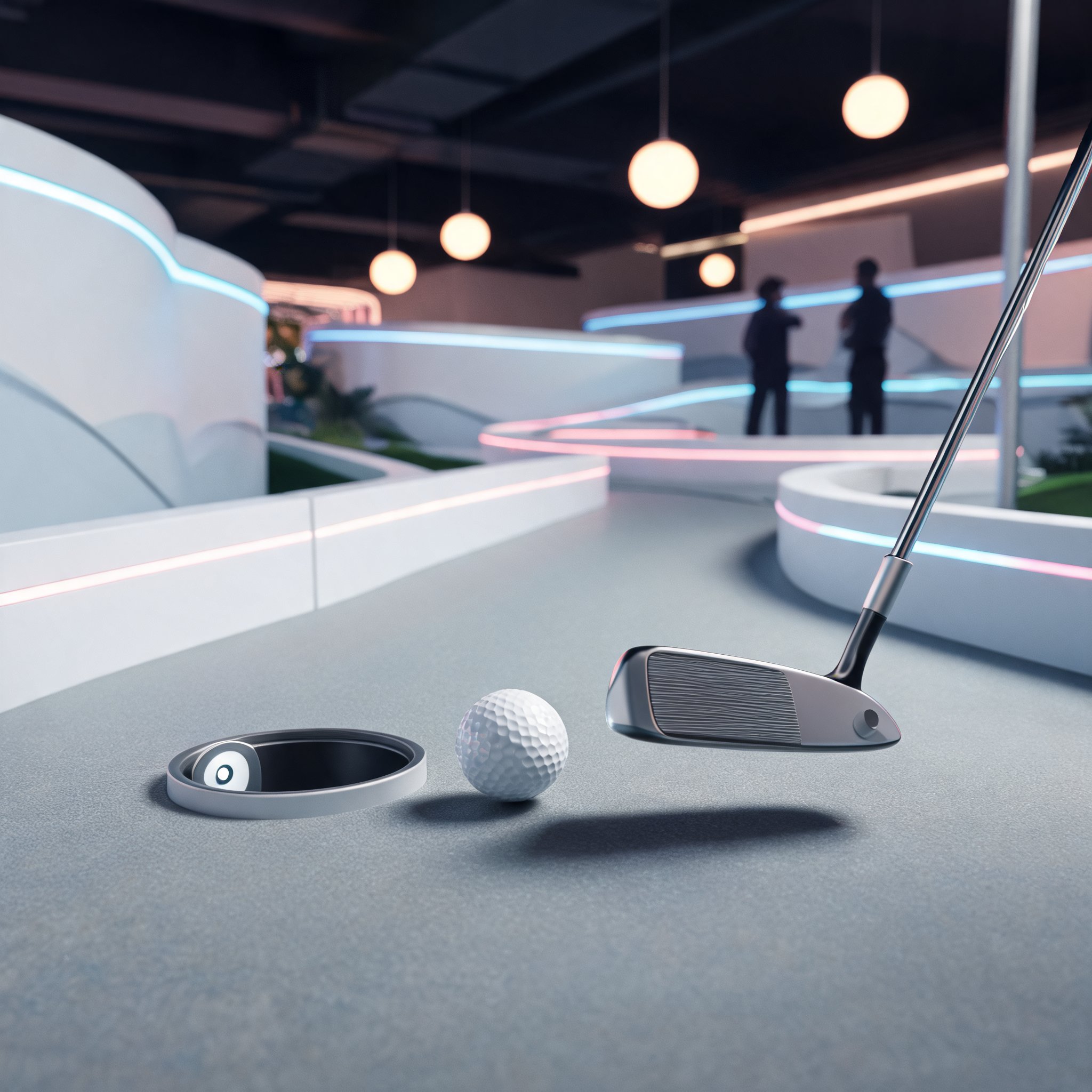
Holovis is using its 360Golf brand to reposition mini golf for the competitive socialising market. Rather than replace the familiar putting experience, the system adds automated scoring, gamified challenges and an analytics layer that links the course to the operator’s wider venue business. The company is preparing to present the platform at IAAPA Expo, where the pitch will centre on a turnkey attraction rather than a course alone.
The core hardware is deliberately simple for players. Smart balls, tees and cups work with Holovis’s HoloTrac scoring system, removing paper scorecards and providing an automatic referee. Visitors can register, collect an assigned ball and begin playing with limited explanation or staff involvement. On top of scoring, 360Golf adds SuperShots that create alternative ways to earn points, Triumphs that issue awards and unlock challenges, plus bonuses, on-course games, player accounts, achievements, leaderboards and video celebrations. These features are intended to give players reasons to compete, compare results and return.
Familiarity as a route into competitive socialising
The company argues that mini golf’s advantage is not novelty but recognition. Stuart Edgington, global director of business development, says the format is already widely understood and accessible, so 360Golf can build technology on top of an established appeal. That positioning is aimed at families, young adults in competitive socialising groups, corporate outings and other audiences that venues may want to combine. The operational benefit claimed is speed: a guest can register and start playing without lengthy briefing, leaving staff to manage the venue, food and drink and guest service.
That is important because competitive socialising venues depend on more than the headline activity. Revenue often comes from dwell time, group spending and repeat visits. 360Golf’s answer is to make the round itself more measurable and more social, while giving operators a reason to bring players back to improve scores or unlock content.
Data moves from scorekeeping to operations
Behind the player-facing features is DeepSmarts, an AI analytics engine that Holovis says can show how players interact with the course, how seasonal demand changes and where operations might be adjusted. The company presents the data as a service layer for clients: it can support decisions on promotions, quieter periods, under-served audiences and course uptime. Maaz Ussen, project manager, says the system can also help engineers diagnose problems remotely by reviewing what happened on course.
The commercial model is designed around throughput. Holovis says a course can handle up to 80 people per hour, and the kiosk-led flow is intended to keep guests moving without consuming staff time. Matt Dobbs, business development director, describes the intuitive system as the main advantage: guests can understand how to play, collect their ball and proceed, while the operational team concentrates on hospitality. The company links that division of labour to higher secondary spend, particularly food and beverage. Those outcomes remain operator- and venue-dependent; the technology supplies the flow and data, but not a guarantee of demand or spending.
One platform, several installation models
360Golf’s flexibility is central to its pitch. Operators can choose a technology-only retrofit for an existing mini golf course, a set of catalogue holes, or a fully custom installation. Holovis says technology-only deployments can be installed in about six to eight weeks, catalogue holes in eight to 12 weeks, and custom courses can take six months or more.
The range of projects illustrates how the same core system is adapted. For Norwegian Cruise Line’s Tee Time, the course uses marine-grade, waterproof equipment and specialist screens for use at sea. At Netflix House, the Top 9 course is a custom, IP-led installation with themes including One Piece, Squid Game and Floor is Lava. Super Social in Leopardstown, Ireland, uses 12 holes from a sports-themed package, while Lucky Duck in Norway has a custom course with two routes for each hole. For multi-site operators such as Saudi Entertainment Ventures, Holovis argues that a common technology base can preserve consistency while allowing variation in theming, layout or branding.
Smaller venues are not excluded. A simpler or more cost-effective course can still use the scoring, replayability and gamified features, which the company says makes 360Golf a possible starting point for operators that may later grow into a chain.
Design, inclusion and the limits of the model
The physical course remains part of the product. Holovis’s creative, software and engineering teams work together on course design, and Dobbs says feedback often focuses on the visual impact created by scenic pieces combined with lighting. At Butlin’s Bognor Regis resort, the £15m PLAYXPERIENCE activity centre includes three nine-hole 360Golf courses: a neon glow course, a Las Vegas-themed course and a wheelchair-accessible music-themed course. Dobbs says the attraction has reached 5,000 players in a busy week and around £40,000 in weekly revenue; those are company-provided figures and depend on the venue’s trading pattern.
The Butlin’s project also fed into Holovis’s work on inclusive design. Ussen cites details such as courses that can be played right- or left-handed, putters in appropriate sizes, wheelchair access close to or onto the course, tees placed near an edge for reach, and spacing between holes to reduce crowding and safety risks. These are practical adjustments rather than peripheral features, because a competitive socialising attraction has to work for mixed-age groups and different levels of mobility.
The main constraint is market fit. Competitive socialising is growing, but Edgington acknowledges it will eventually reach peak saturation. 360Golf’s response is to pursue venues beyond dedicated mini golf, including cruise ships, family resorts, multi-site entertainment developments and smaller independent operators. Holovis is also testing adjacencies: it is working with Roxy Leisure to add stroke-counting technology to its crazy pool tables and wants to apply its scoring technology to other sports.
For operators, the decision is therefore not simply whether to buy a mini golf course. It is whether the venue has the footfall, group mix and hospitality capacity to turn a fast, gamified round into repeat visits and secondary spend. 360Golf’s pitch is that automated scoring and data can improve that equation; the evidence offered so far is a set of company-selected installations and performance figures, rather than a universal outcome. The platform’s prospects will rest on how consistently those results can be reproduced across very different sites.