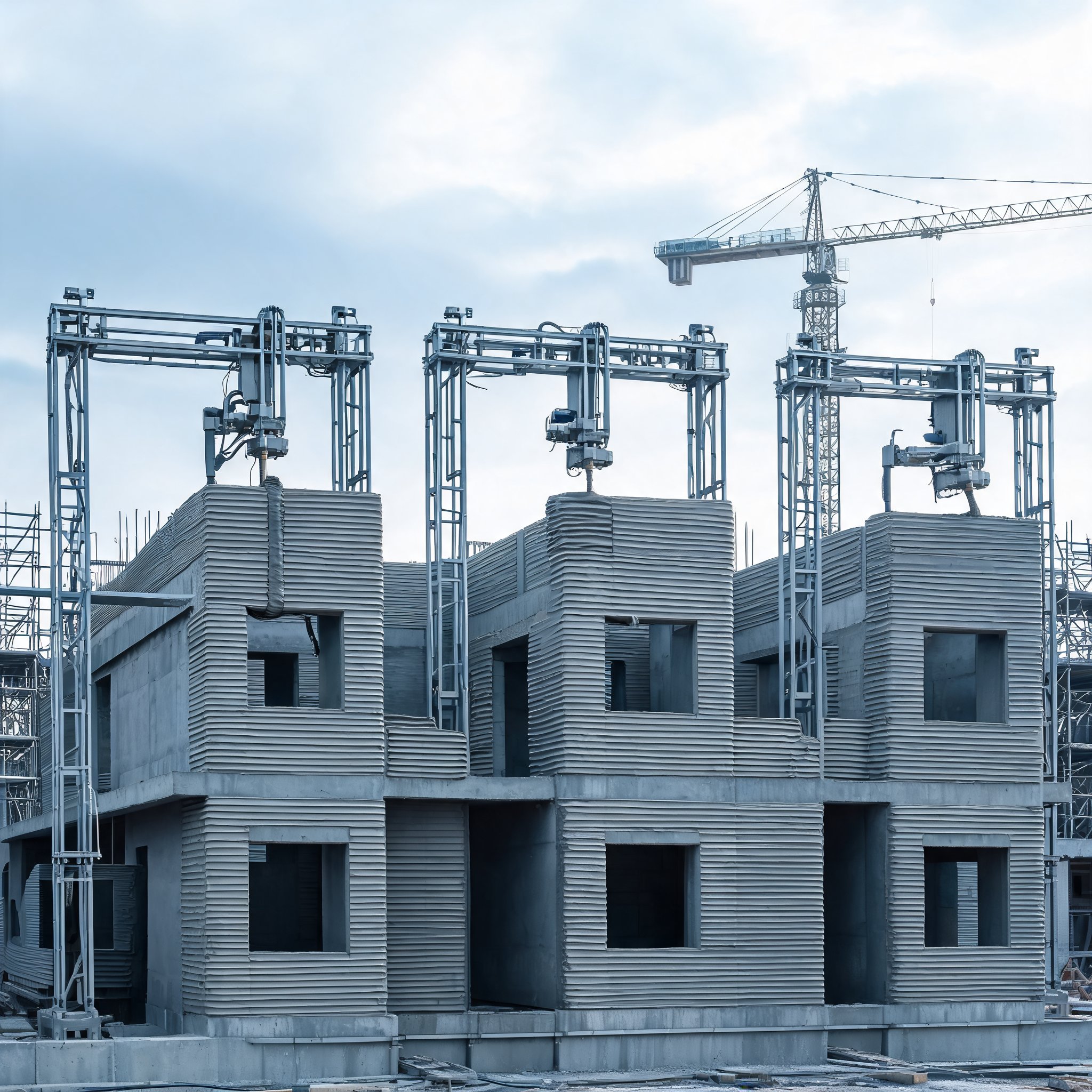
Florida-based construction 3D printer manufacturer AMTG has revealed that three of its G2 gantry systems were used together to produce the printed wall system for the Mella shopping center. The commercial construction project was developed by an AMTG customer and relied on three synchronized G2 construction 3D printers working in a coordinated workflow.
According to AMTG, long wall sections, openings and architectural transitions were formed directly during printing. Using several printers allowed the project team to distribute work across the building footprint rather than depending on a single machine.
Coordinating three construction 3D printers
AMTG describes the G2 as a high-reach gantry construction 3D printer designed for large building projects. Its modular Cartesian structure can be configured according to building geometry and site requirements. For Mella, the three systems produced long wall sections, openings and architectural transitions directly during printing.
The company has not disclosed how the three printers were synchronized, including whether they operated simultaneously under centralized control or followed coordinated production schedules. Even so, the project illustrates an approach to scaling construction 3D printing by deploying multiple gantry systems instead of a single machine.
AMTG's involvement was limited to supplying the printing systems, operator training and equipment-operation certification. Structural design, materials and construction remained the responsibility of the customer's qualified professionals.
Printer families and wider adoption
Beyond the G2, AMTG offers three construction 3D printer families. The R-Series includes road-mobile and tracked robotic systems for rapid deployment, the G-Series covers gantry printers for on-site construction, and the F-Series focuses on factory-controlled production of prefabricated components.
Construction companies are increasingly integrating 3D printing into commercial building projects. In the United States, Alquist announced an expansion of its construction 3D printing operations through a partnership involving Walmart, construction firm FMGI and equipment supplier Hugg & Hall. The initiative covers more than a dozen commercial projects and includes equipment deployment, operator training and technical support, a model in which contractors incorporate 3D printing into their existing construction operations.
In Germany, construction group Matthäi established a dedicated 3D printing division after completing a two-storey office building. Using a COBOD BOD2 printer, the company produced the building's walls in approximately 105 hours, while foundations, floors and roofing were finished using conventional methods.
Expanding capacity and reach
Other construction 3D printing projects are exploring ways to increase production capacity and extend the areas covered by automated equipment. In France, the ViliaSprint² development used a COBOD BOD2 printer to construct a three-storey, 12-apartment residential building. Its walls and load-bearing structure were printed in 34 days, against an initial estimate of 50 days. The project partners are planning a larger development involving two printers operating simultaneously.
In Australia, construction technology company Luyten 3D introduced its ASCEND A27, a tower crane-mounted concrete 3D printer with a working radius of up to 45 meters. Unlike conventional gantry systems, the ASCEND is designed to cover larger construction footprints from a single installation point.