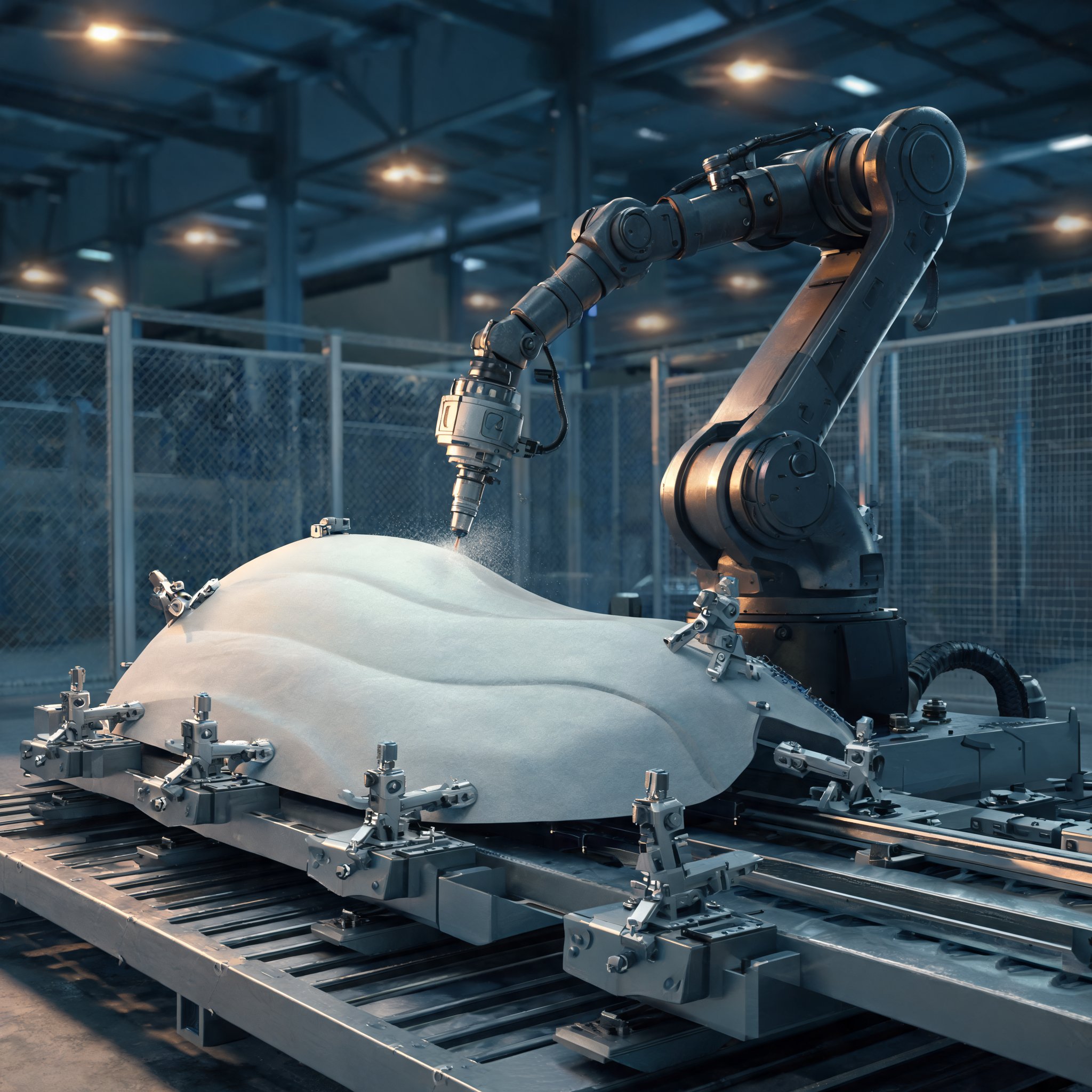
The Liné Machines RoboTDM, offered by Fives High Precision Machines (Fives HPM), is designed to machine large workpieces with an industrial robot rather than a large CNC machine tool. A spindle, toolholder and cutter are carried by a specialized end effector, allowing the robot to remove material directly from the part. Fives says the configuration can shorten setup, simplify programming and avoid the cost and footprint of a large machine while adding flexibility.
The system is intended for applications where tolerances down to approximately 0.1 mm are acceptable. Potential operations include face milling and deburring, such as removing burrs from castings or trimming excess weld beads. It could also drill pilot holes in large aerospace panels or automotive body parts and perform trimming, routing, drilling, edge contouring and pocketing on large composite or thermoplastic fabrications.
Closing the accuracy gap
Conventional industrial robots have generally achieved positional tolerances of about 0.3 mm, a level that Fives describes as insufficient for many machining tasks. The RoboTDM development program focused on closing that gap through high-precision robotic machining. Robot calibration, look-ahead and motion-planning algorithms allow programs with more than one million points to be processed without latency that could otherwise compromise motion, according to Fives. The company says the result is smoother trajectory execution and support for multi-axis contouring and complex operations closer to CNC performance.
Fives reports that RoboTDM can bring machining deviation down to about 100 μm (0.1 mm), which it describes as a threefold improvement over conventional robotic accuracy. That does not make the system a universal replacement for CNC equipment. Where tolerances tighter than 0.1 mm are required, Fives says a high-precision CNC machine remains the appropriate choice, positioning RoboTDM as complementary to Liné Machines and the wider Fives HPM machine-tool portfolio.
Configurable machining package
The end effector can be configured with different spindle sizes, power ratings, torque and speed. Available systems offer spindle power up to 125 kW, torque up to 80 Nm and speeds reaching 30,000 rpm, with HSK A63, HSK F63 or HSK A100 taper toolholders. Fives says RoboTDM can also include automatic tool changing, tool measurement, tool-breakage detection and part probing, while a vision system can support drilling. The same robot platform can be configured for waterjet cutting, laser profiling and ultrasonic cutting.
The robot's physical flexibility is particularly relevant for components that are too large or awkward to move through a conventional machine tool. RoboTDM can be configured with multiple workstations and customized peripheral equipment, and its relatively modest foundation requirements simplify installation compared with a large CNC machine, according to Fives. The company sees aerospace, defense, maritime and energy as likely sectors because component dimensions can be substantial and production requirements vary.
Fives says a multi-year research and development project and development trials demonstrated cycle-time reductions of up to 70% in trimming and milling, with some individual applications achieving greater savings. The company frames the technology around a practical question for manufacturers: whether an application truly needs a large CNC machine or merely a reliable, accurate way to position a cutting tool.
RoboTDM is part of Fives' Material Removal business line and reflects the company's "precision at scale" cross-brand message. Fives Liné Machines Inc., now part of Fives HPM, has operated in North America for almost 50 years through its Granby, Quebec, Canada, facility. The plant produces Liné CNC machine tools and robotic solutions including RoboTDM, and the site supports engineering, integration, automation, service and training across equipment lifecycles.
Fives says the development originated from customer requirements and reflects an effort to engineer solutions around specific manufacturing challenges rather than force applications into standard equipment. For suitable large parts, the company argues, RoboTDM can offer lower capital investment, simpler installation, greater flexibility and shorter cycle times than a large CNC machine.