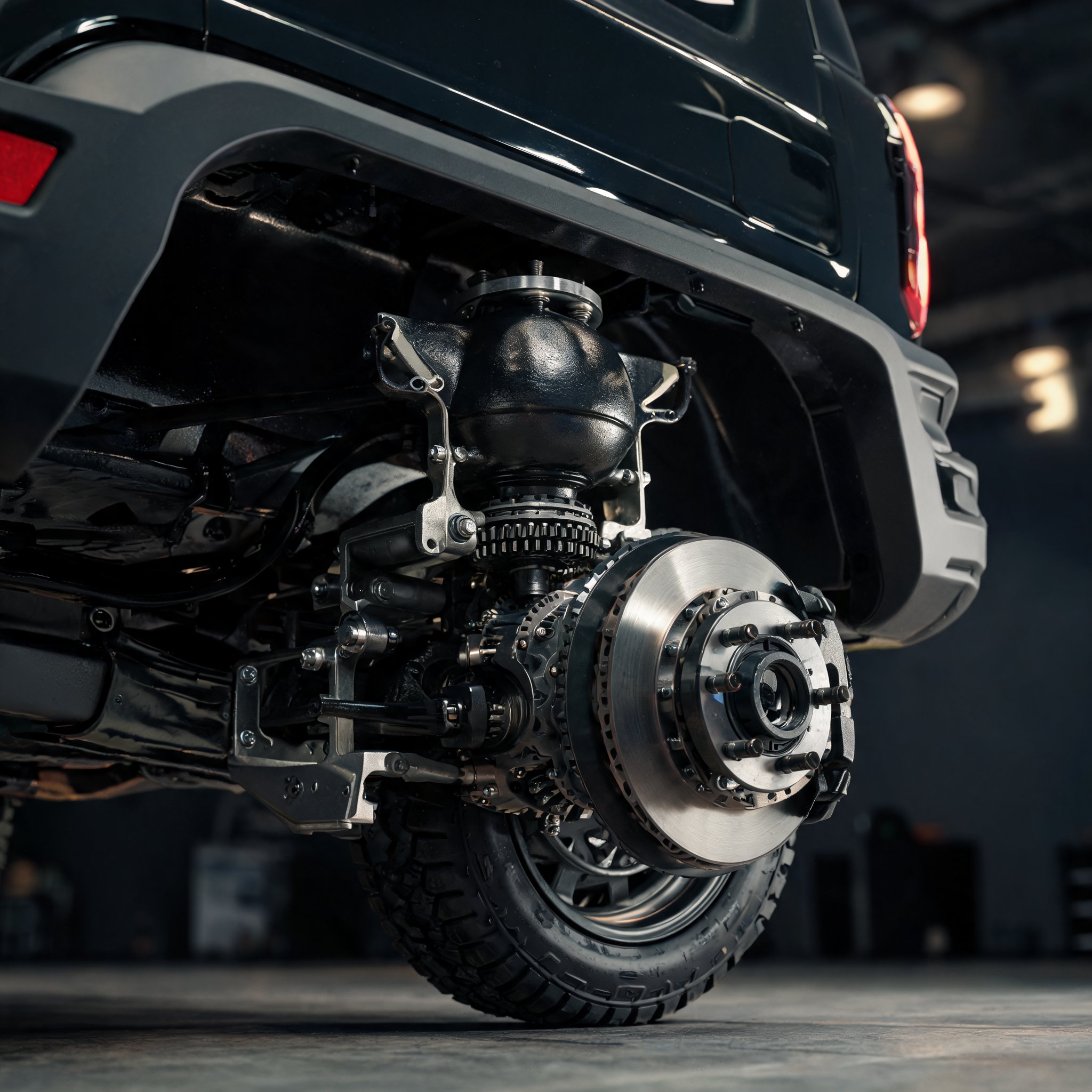
Zeph Gage has completed a rear portal-axle conversion for his Jeep XJ using a flipped Ford 9-inch differential, Humvee geared hubs and a substantial amount of custom fabrication. The project is meant to deliver the clearance benefits of portal axles at roughly one-fifth the cost of a typical set.
Portal axles place a gear stack behind each driven wheel instead of relying on axle tubes and a differential that hang below the chassis. That arrangement raises the axle shafts and leaves less hardware below the frame, making room for taller tires and greater ground clearance. Typical portal-axle sets from suppliers such as 74Weld cost about $20,000; the unit on Gage's Jeep costs about $4,000.
Gage's rear assembly combines a Ford 9-inch axle housing, Humvee geared hubs and HMMWV portal adapters from Jesse Haines Fabrication. Two-gear Humvee portals reverse the rotation of the input shaft. To correct the direction, Gage mounted the Ford 9-inch differential upside down. A Yukon Gear and Axle third member is bolted to the inverted differential, creating a budget high-pinion arrangement from low-pinion parts.
The conversion is described as adding about six inches of clearance while retaining full shock travel, a combination that can be difficult to achieve with portal axles. It is also intended to reduce stress on the differential. Those durability and clearance benefits are design claims; no independent testing is cited.
Using a portal only at the rear is a common approach in remote-control rock crawling. Keeping the front solid axle avoids packaging constraints that can arise when adding portals to a vehicle that never had them from the factory. It also lets Gage preserve shock travel and keep ride height from rising excessively. The resulting vehicle has extra rear clearance, so the rear end is less likely to hang up on obstacles that the front end can steer around. The rear-only layout keeps the front end's steering and suspension packaging largely conventional.
The setup is not an off-the-shelf kit. Gage made custom brackets and tapped plates, and he used a two-piece brake rotor paired with a Ford Fusion caliper. The Fusion hardware was chosen partly for its integrated electric parking-brake solenoid and partly for clearance. That mix of factory parts and custom work is central to the low-cost approach, but it also means the conversion depends on fabrication rather than a bolt-on kit.
The finished Jeep XJ can drive over a five-gallon bucket and still have several inches of clearance left. Gage also matched the gearing front and rear, a detail covered in an Outdoor Auto video about the build.