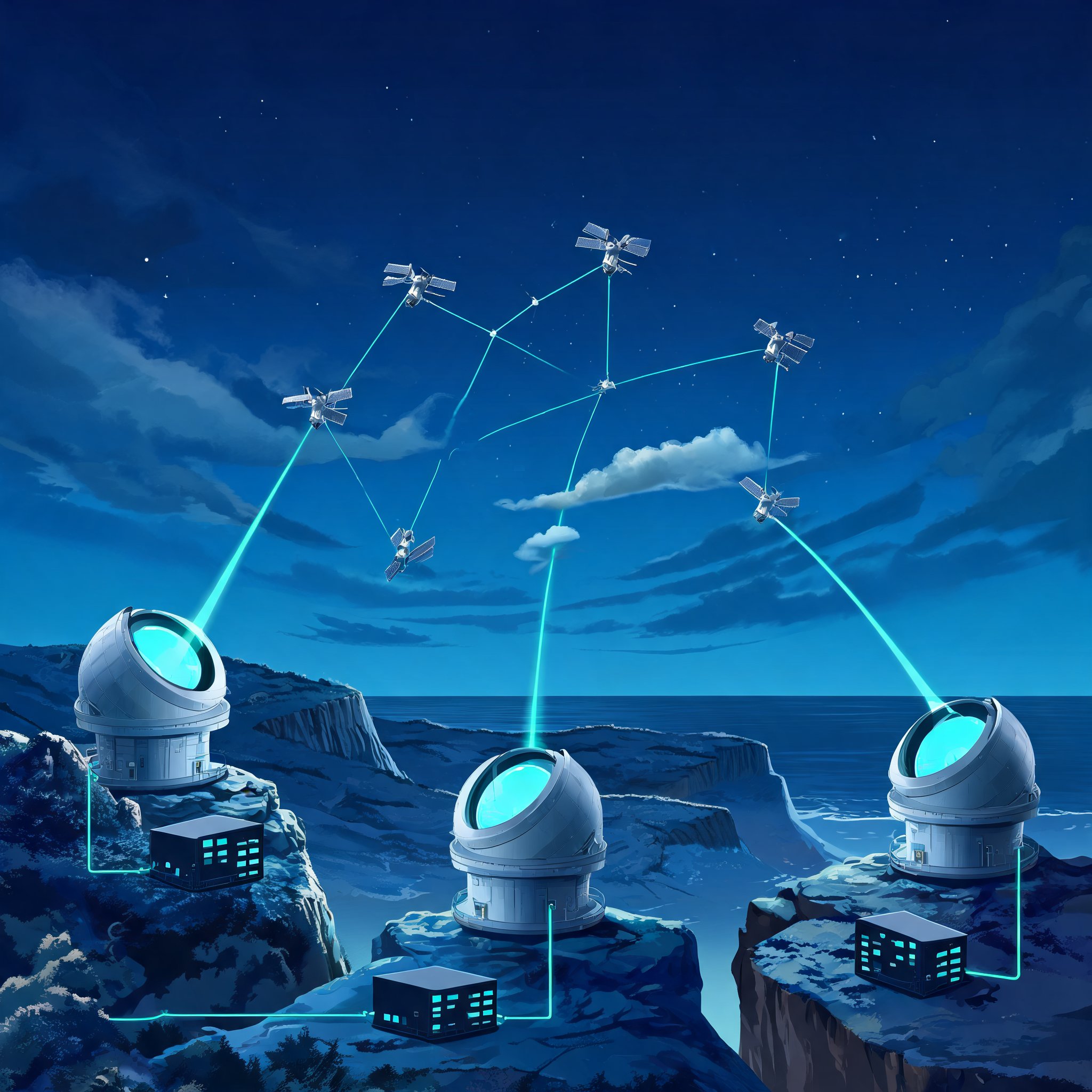
NTT and SSC Space have signed a memorandum of understanding to explore how optical ground stations in different parts of the world can work together, with the aim of making laser-based communications between satellites and Earth more reliable.
The memorandum was signed on 11 November and announced on 20 November. Under the agreement, NTT will contribute optical communications and network control technology, while SSC Space will provide its global ground station infrastructure and operational expertise. The companies said they would examine the potential for medium- to long-term collaboration. They did not disclose financial terms or a timeline.
Why optical ground stations matter
Optical ground stations use laser light, rather than radio, to communicate with satellites. According to the announcement, optical links are expected to deliver higher speeds and greater capacity as satellite constellations, Earth observation and other space uses expand. But cloud cover can block a laser beam, creating a reliability problem for any single site.
To address that, the companies will study site diversity. In this approach, several optical ground stations are spread across different locations, and traffic switches to another station when clouds make one site unavailable. The method depends on interoperability: equipment and services from different providers must be able to work together.
Network control and routing
Slides from a keynote by NTT president and CEO Akira Shimada at a forum said optical links offer tens to hundreds of times more bandwidth than radio. The presentation described NTT’s network control technology as using AI to predict and select the best route between satellites and ground stations, based on weather data and satellite positions as well as the status of ground stations and the network.
Under the memorandum, the companies will examine interoperability between their technology and service environments, along with site diversity. They will also look at how the service could connect with land-based networks and share information on the optical satellite communications market and customer needs.
Global footprint and next steps
SSC Space, which has around 750 employees according to the Swedish government, runs a global network of ground stations used to communicate with satellites and owns and operates Esrange Space Center outside Kiruna in northern Sweden. According to the announcement, its ground stations support both optical and radio communications.
Minako Tsumenaga, senior vice president and head of the alliance department in NTT’s research and development market strategy division, said wider use of optical satellite communications would depend on more than the ground stations themselves. “The widespread adoption of optical satellite communications will require not only high-performance optical ground stations, but also mechanisms for connecting and operating them on a global scale,” she said.
Charlotta Sund, president and CEO of SSC Space, said the agreement reflected the company’s investment in optical communications. “This agreement marks a significant milestone for SSC Space in optical communications and reflects our investments in this innovative business segment,” she said.
The SSC Space memorandum is the latest space agreement under NTT C89, a brand NTT launched in 2024 to bring its space projects together. Earlier this month, NTT signed a memorandum with Safran DS to bring its IOWN optical network technology into Safran DS’s optical ground stations. In September, it announced a collaboration to connect France-based Cailabs’ optical ground stations to NTT data centres through its All-Photonics Network.
According to materials NTT shared with media at its R&D Forum in Tokyo, radio links between satellites and the ground limit both how much data can be sent and how often. NTT cited a projection that satellite data volumes will reach 230 petabytes a day by 2033. NTT said it aims to connect space-based optical terminals, optical ground stations, land-based optical networks and data centres into end-to-end infrastructure running from space to the ground, and to build an open ecosystem with satellite constellation operators, ground station providers, telecommunications carriers and data centre operators.