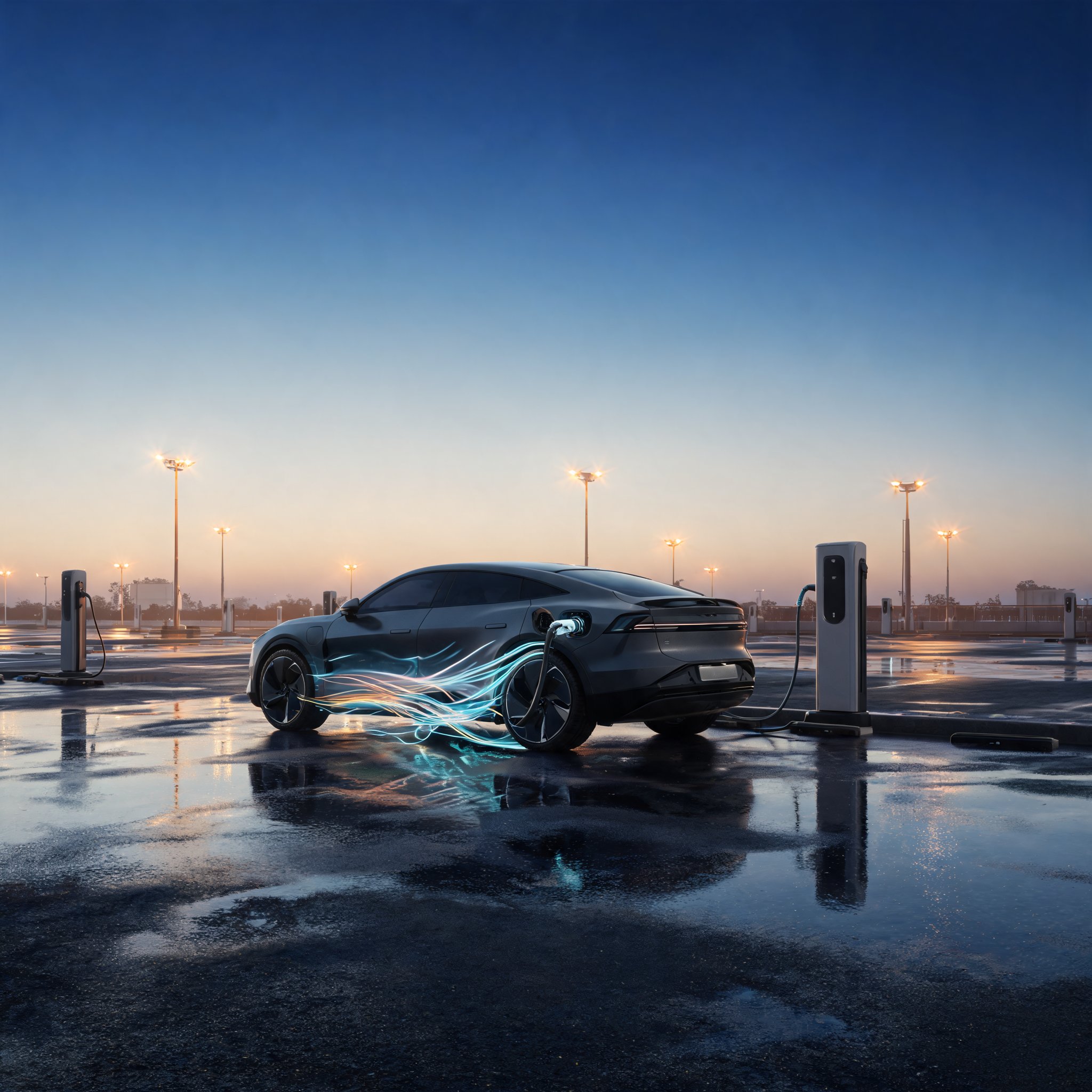
Porsche has extended its largest SUV family with a fully electric Cayenne, and the mid-range S Coupé tested here demonstrates how far the company has developed its Premium Platform Electric (PPE) beyond the Macan that shares the same foundation. The most convincing evidence is not the drivetrain output but the fast-charging behaviour, where the data-sheet figures largely translated into repeatable real-world performance.
A three-tier electric Cayenne line-up
The Cayenne Electric had its world premiere in November 2025, and series production began in Bratislava in early February 2026. Porsche added the S in Coupé form in March as the middle rung of the range. The S produces up to 400 kW in normal driving and 490 kW with Launch Control, sitting between the base model at 300 kW (325 kW with Launch Control) and the Turbo at 630 kW (850 kW with Launch Control). With Launch Control, Porsche quotes 0–100 km/h in 3.8 seconds for the S, 4.8 seconds for the base car and 2.5 seconds for the Turbo, with top speeds of 250, 230 and 260 km/h.
Reworked drivetrain and a new cell format
Both axles use permanently excited synchronous machines. The front motor is essentially carried over from the Macan, but the rear axle of the S and Turbo uses a specially developed oil-direct-cooled unit; the base model relies on a water-cooled drive. Porsche extracts the Turbo's extra output not from a different motor but from a longer version of the same design, while the S receives the shorter one. In the oil-cooled motor, a non-conductive oil draws heat directly from the copper windings rather than through an outer water jacket, which Porsche says helps sustain performance under load and contributes to a motor efficiency of up to 98 per cent. The company also cites this cooling as one reason the more powerful S can achieve a slightly longer range than the base model.
The battery has a gross capacity of 113 kWh, of which around 108 kWh is usable, arranged in six modules with 192 pouch cells, a change of cell format from the Macan's prismatic cells. The chemistry is also new: a nickel-rich NMCA cathode with roughly 86 per cent nickel and an anode containing six per cent silicon raise energy density by about seven per cent over the previous NMC-811 chemistry. The pack holds eight kilowatt-hours more than the Taycan's while being around 103 litres more compact. Two cooling plates per module heat or cool the cells from above and below, and Porsche says the pressure fans used for this consume about 15 per cent less energy than conventional suction fans.
Charging performance in practice
Full charging power is available only within a specific battery temperature window, and the pack can be pre-conditioned automatically through the Charging Planner once a charging stop is set as a navigation destination. Porsche offers no manual trigger, so a spontaneous stop without route guidance cannot deliberately pre-heat the battery.
The charging curve is designed to peak early. According to the report, more than 300 kW is available from around five per cent state of charge (SoC), with the theoretical maximum at roughly 55 per cent. In the recorded session at an EnBW HyperCharger starting at nine per cent SoC, 333 kW was available at 12 per cent and around 360 kW from 13 per cent, rising to a maximum of 386 kW at 44 per cent. The full 390 kW claimed in the data sheet was not reached, which the piece attributes to the charger rather than the car: Porsche supplies 390 kW only above 520 amps, while the HyperCharger delivers a maximum of 500 amps. For 400 kW, Porsche specifies an even narrower window of above 850 volts, a battery temperature of 40 to 42 degrees Celsius and an SoC of 45 to 48 per cent.
What matters most for the shortest possible stop is the time to 80 per cent. After the first drop in power, the Cayenne continues at around 290 kW; between roughly 60 and 71 per cent it holds around 270 kW, and at 80 per cent it still draws 183 kW before falling significantly. The measured 10 to 80 per cent time was around 16 minutes, matching Porsche's specification.
Quiet Charging: less noise, same time
The cooling fans are noticeably loud during and shortly after fast charging, which prompted a second session using Quiet Charging at the same charger. This Porsche mode, which can only be activated manually via the display after charging has begun, reduces fan speed alone, lowering cooling performance and allowing the battery to heat up sooner. In the comparison, the same 10 to 80 per cent charge again took about 16 minutes and the peak was almost identical at 385 kW, though the curves differed: in Quiet mode the high plateau ended at 42 per cent, so at 44 per cent it delivered 325 kW against 386 kW in Normal mode. The report stresses that a single measurement cannot be generalised; outside temperatures were around 20 degrees, and Porsche says a noticeable performance reduction only occurs at high starting battery and ambient temperatures, giving as an example a 10 to 80 per cent session at a starting battery temperature of 35 degrees and 45 degrees ambient, where charging time can extend by about a minute.
Chassis, weight and options
Acceleration is only part of the picture: the standard S Coupé is listed with a kerb weight of 2,560 kilograms. Adaptive air suspension with electronic damper control is standard, and the test car added Porsche Active Ride at €8,324, whose active dampers connect to a motor-pump unit on each axle and generate targeted forces at each wheel without mechanical stabilisers. In Comfort mode the system can overcompensate for roll and pitch to reduce the forces on occupants; in Sport and Sport Plus the body stays flat without becoming uncomfortably hard, though the mass cannot be fully masked and the car understeers if pushed hard. Rear-axle steering, at just under €1,700, is recommended, shrinking the turning circle from 12.7 to 11.6 metres. Regenerative braking is blended into the brake pedal with an almost imperceptible transition; the ceramic brake system on the test car costs €10,100.
Range, consumption and price
For the tested configuration Porsche quotes a combined WLTP range of 616 kilometres, while the S Coupé line extends up to 669 kilometres, the S SUV up to 653 kilometres, the base model up to 661 kilometres and the Turbo up to 637 kilometres. On mixed routes, consumption ranged from around 20 to 27 kWh/100 km depending on speed, settling near 24 kWh/100 km in everyday driving. Using the 80 to 10 per cent window, the report estimates roughly 315 kilometres of real-world travel between charging stops. A 22 kW AC charger is optional at €1,666, cutting a 0 to 100 per cent charge from 11 to 5.8 hours, while standard AC power is 11 kW; inductive charging with 11 kW and around 90 per cent efficiency has been orderable since the September 2026 model year for €5,117. The S Coupé starts at €130,300, but the tested example carried €69,440 of options for a total of €199,740, and Porsche's extensive and costly options list is flagged as a persistent characteristic, with substantive features such as Active Ride being the exception. The electric Cayenne competes with the BMW iX5, the Mercedes EQS SUV and the Audi SQ8 e-tron.